Stronger Together
A quick guide to the history of Wisconsin's Lake Superior Basin Partnerships and why it matters
Val Damstra, Associate Director for Operations, Burke Center for Ecosystem Research, has worn many hats since arriving in Ashland in 2009. They all in some way involved promoting partnerships among the conservation agencies working in Wisconsin's Lake Superior Basin, which includes Iron, Ashland, Bayfield, and Douglas Counties. Most of the rain that falls in these counties eventually flows into Lake Superior, which means that the nearshore health of Lake Superior is heavily dependent on what happens in these watersheds.
History
"My first job when I moved to Ashland in 2009 was working for the Bad River Watershed Association [now Superior Rivers Watershed Association]," says Val. "My first day on the job I went to a Lake Superior Basin Partner Team meeting. I was struck by how well the partners worked together and openly shared. It was impressed on me right away that this is how the business of conservation gets done here."
The partners in this geography had already been collaborating for a long time before Val arrived. Here is a quick summary of the partnerships and a timeline.

Timeline showing the succession of Wisconsin's Lake Superior Basin partnerships from 1998 to 2026.
- Lake Superior Basin Partner Team – 1998–2012. The Wisconsin Department of Natural Resources (WDNR) originally formed the team to advise the state on carrying out the Lake Superior Binational Program. The priorities at the time were mercury reduction, water quality, and reducing runoff and sediment at a watershed scale ("slow the flow"). Citizens, government and industry representatives worked together to protect Lake Superior and its drainage basin. Coordination by UW-Extension.
- Chequamegon Bay Area Partnership – 2009–2017. The Chequamegon Bay Area Partnership (CBAP) formed in response to the U.S. Environmental Protection Agency's Great Lakes Restoration Initiative (GLRI). Funding was now available for improving the ecological, economic, and social fabric of the region. Priorities were improving fish passage through culvert replacements, beach sanitation, and watershed restoration. This group also hosted an annual symposium to share information about projects and research. Coordination by Northland College.
- Lake Superior Landscape Restoration Partnership (LSLRP) – 2014–2017. The Chiefs of the United States Forest Service and Natural Resources Conservation Service identified this geography as a landscape deserving additional attention and resources. The Partnership identified priority geographic areas and best management practices. They implemented a comprehensive program to coordinate conservation work across ownership boundaries, including private landowners. Priorities included water quality, fish passage, outreach to private landowners via EQUIP funding, reduction of hazardous fuels, and sharp-tailed grouse translocation. Coordination by UW-Extension.
- Lake Superior Collaborative – 2019–present. The newest version of a collaborative partnership focuses on collaboration, networking, and knowledge-sharing. The conservation priorities continue to be water quality, replacement of aging infrastructure (especially old culverts that prevent aquatic organism passage), ecosystem restoration, and community outreach. The Collaborative continues to host an annual symposium to share information. A high priority is to sustain the partnership over time without regard to specific funding and other initiatives. Coordination by UW-Extension.
Persistence
What is noteworthy about this 28+ year timeline is the persistence of the agency partners to keep working together, regardless of where the funding was coming from.
"The earlier partnerships were driven by short-term, time-limited funding opportunities," says Damstra. "The strength of the partnership ebbed and flowed depending on the specific funding initiatives. But we've learned that the strength of the partnership is to persist regardless of funding. The ability to get more funding and do great work comes from keeping communication and relationships consistent. The challenge is that any partnership requires coordination, and coordination requires funding too."
UW-Extension has had a coordination role in all the partnerships except the Chequamegon Bay Area Partnership, which was coordinated by Northland College. The coordinator position has been vacant several times, which complicates planning and organizing cooperative efforts like hosting a symposium or bringing partners together to cooperate on projects. "Funding for a coordinator is essential for sustaining a strong partnership. Someone must take the lead and 'herd the cats'," says Damstra.
The timeline shows that the Chequamegon Bay Area Partnership overlapped with the Lake Superior Basin Partnership Team in the early years and with the Lake Superior Landscape Restoration Partnership in later years. Each partnership had a role to play in advancing cooperative conservation. However, the lack of a unified effort in a relatively small geographic area stretches the capacity of the partners to cooperate and adds confusion.
"The LSC was a major turning point for us," says Damstra. "Michele Wheeler, Jennifer Masziasz, Tony Janisch, and I planned a partner meeting for November 2017; we hired a facilitator to help us. This meeting ultimately led to the decision to merge the CBAP and LSLRP partnerships into one — the LSC. Going forward, we hope to sustain the LSC as a unified partnership and avoid duplication."
Priorities
Throughout the long history of Lake Superior partnerships in Wisconsin, the on-the-ground conservation priorities haven't changed much. Documents from past workshops and strategic plans show that problems like excess sediment runoff during high rainfall events, aging infrastructure like old or poorly designed culverts that impede fish and other aquatic organism passage, invasive species, and declining populations of brook trout, sharp-tailed grouse, Kirtland's warblers, and reduced wild rice beds have been major drivers behind restoration priorities. The goals and objectives of the various partnerships have been written in many ways, but the essence of the needs hasn't changed.
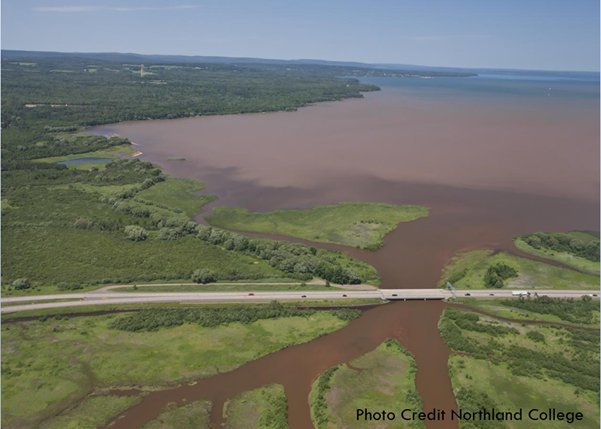
"The region is still recovering from the Great Cutover, when almost the entire region was logged," says Damstra. "Recovery of the landscape from the cut-over years is on display every time it rains. Runoff from the major streams and rivers literally turns the nearshore area of Lake Superior brown. I was shocked the first time I saw it after moving here. The sediment plumes can even be seen in photos taken from space. 'Slow the flow' is one of the mantras of the conservation community here to mitigate the excess sediment and runoff."
Sediment runoff into Lake Superior following heavy rainfall. Photo credit: Northland College.
Secrets to Success
Inspired Leadership
Many successful initiatives have one or more committed and talented leaders. The LSC is no exception. "Michele Wheeler was one of the best collaborative leaders I've ever worked with," says Damstra. "She demonstrated that good leadership is just as much about listening as it is about expressing ideas. She had a special skill with moderating between different viewpoints to find common ground."
Having Fun
"Michele also showed us that in addition to working hard, it was just as important to have fun," says Damstra. "I was taking a job with the Burke Center and leaving the LSC Coordinator position. Most of the steering team members were local, but at that time, Kyle Magyera with Wisconsin Wetlands Association often joined the meetings by speakerphone. (This was before we commonly used video conferencing). Michele had gotten a picture of Kyle enlarged into a cardboard cut-out so that 'Flat Kyle' could 'attend' my last meeting. She had Kyle and the whole steering team in on it — it was hilarious! She just had a great way of getting things done and making work fun at the same time."
Collaboration with the Tribes
"In our region, partnerships have been stronger from engaging with the Tribes," says Damstra. "Involvement of the local Tribal natural resources departments (Red Cliff, Bad River) and the Great Lakes Indian Fish and Wildlife Commission (GLIFWC) as partners is essential."
In more recent years, partners are embracing the Ganawenindiwag Shoreline Restoration Guide developed by GLIFWC, the Lake Superior National Estuarine Research Reserve, UW Extension, and the Lake Superior Research Institute. "This is an amazing resource for shoreline restoration practitioners to incorporate indigenous knowledge and practices in selecting native plants," says Damstra.
The Future of the Lake Superior Collaborative
Pitch Parties
"Funding comes and goes; sometimes there is a lot of funding available for projects and sometimes not," says Damstra. "Regardless of the funding sources, we need 'shovel-ready' projects focused on priority needs to meet short timelines for grants. I'm really excited about the 'pitch party' process that we're developing; it's super-cool."
The idea behind pitch parties is to document and develop project ideas long before any grant proposal is written. Early project ideas are pitched to small teams of conservation partners and funding agencies, who provide rapid feedback to make the project better or more collaborative. The resulting projects provide more comprehensive conservation on the ground by addressing multiple objectives in one locale or similar objectives in multiple locations.
Sustaining the Partnership
"We need to keep the LSC Coordinator role filled," says Damstra. "It's very difficult to maintain interagency partnerships without a coordinator."
"The LSC is the container," says Damstra, "and any new initiatives can be incorporated into it. If we don't let it lapse, we won't have to reinvent it when new funding or other opportunities become available. My mid-career peers and I are continuing to instill in new employees the importance of collaboration. We're now the mentors for the next generation. It's important for us to share with young professionals that working collaboratively is the best way to get things done, as we've seen it work in this region for a long time."